
Key takeaways
Inbox providers have raised the floor on what a “trusted sender” looks like — authentication, low complaint rates, and one-click unsubscribe are now table stakes. Inbox providers have raised the floor on what a “trusted sender” looks like — authentication, low complaint rates, and one-click unsubscribe are now table stakes, not best practices. AI is also the new first reader of your email, meaning subject lines, preview text, and content structure have to make sense to a model before they ever reach a person. And strategy without deliverability is just expensive spam; fix the foundation first.
On the sending side, lifecycle automations beat campaign blasts. The brands winning in 2026 send fewer, better-timed, more relevant messages to smaller segments. Open rates are no longer a primary metric either — inbox placement, complaints, conversions, and revenue per recipient tell the real story. Use AI for analysis and timing, not for cranking out more volume. More email is rarely the answer.
Email marketing has been declared dead more times than anyone can count. In 2026, it’s still here, still cost-effective, and still the highest-ROI channel most marketing teams have. What’s changed is that the bar to make it work has moved up. Inbox providers are stricter. AI is filtering, summarizing, and ranking your emails before subscribers see them. Privacy rules pushed third-party data off the table. Subscribers are quicker to unsubscribe, mark as spam, or just quietly disengage.
This guide is built for marketers who want a strategy that survives 2026, not just a list of tactics that sounded good in 2022. We’ll walk through what actually changed, the three layers of a strategy that holds up, and a 30, 60, 90 day plan for where to start.
What changed in email marketing in 2026
If you’re still running the playbook you wrote in 2022, your numbers are probably softer than they should be. Here’s what shifted, and why it matters for strategy.
Inbox providers got stricter, and the rules now have teeth
Gmail and Yahoo’s bulk sender requirements, which began rolling out in 2024 and tightened through 2025 and 2026, made authentication, one-click unsubscribe, and a low spam complaint rate non-negotiable. Senders who don’t meet the bar see messages rejected, throttled, or quietly routed to spam. Microsoft followed with similar tightening for Outlook and Hotmail.
What that means for strategy: deliverability moved from a technical afterthought to a strategic prerequisite. You can have the best campaign in the world, but if your DMARC isn’t set up, your spam complaint rate is climbing, or you’re missing list-unsubscribe headers, the campaign loses before it starts.
AI is the new first reader of your email
Major inbox clients now use AI to filter, summarize, prioritize, and surface email. Subscribers see your subject line, your preview text, and increasingly an AI-generated summary of your message before they read a single word you wrote.
What that means for strategy: emails need to be readable to both humans and machines. That changes how you write subject lines, structure body copy, and use images. Image-only emails, clever-but-unclear subject lines, and burying the point three paragraphs in are all riskier than they were two years ago.
Privacy made owned data your most valuable asset
Third-party cookies are largely gone. Tracking pixels are less reliable post-Apple’s Mail Privacy Protection. Open rates can be inflated by privacy-protective pre-fetching, which makes them less trustworthy as a signal.
What that means for strategy: zero-party and first-party data are now the foundation, not a bonus. Preference centers, progressive profiling, and behavioral signals you collect directly are doing the work that third-party data used to.
Open rates are no longer a primary metric
Because of pre-fetching and bot opens, “open rate” is now a directional signal at best. Engagement-driven decisions need to lean on clicks, conversions, complaint rate, unsubscribe rate, and revenue per recipient.
Subscribers expect relevance, control, and quiet
The volume war is over and senders lost. People want fewer emails, more useful ones, and an obvious way out if a brand stops being relevant. Frequency restraint is now a strategic choice, not a missed opportunity.
The three layers of a 2026 email strategy
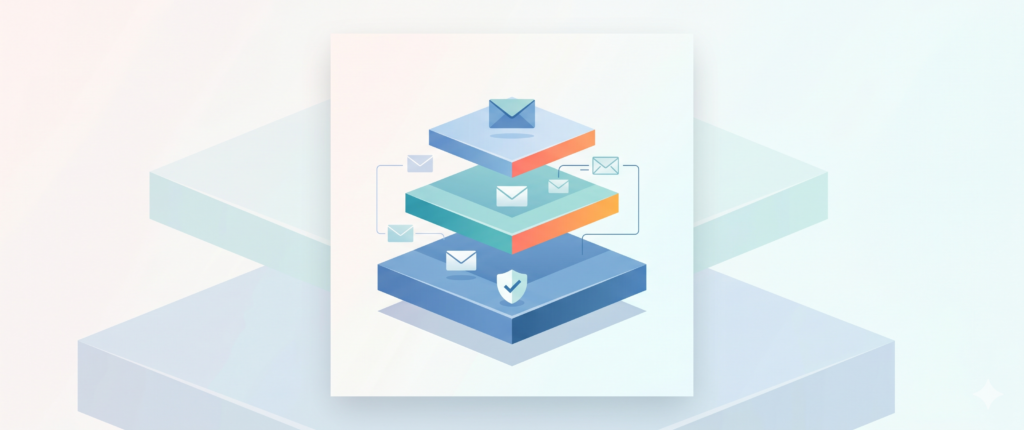
Most strategy guides give you a flat list of nine to thirteen things to do. That’s not a strategy, that’s a backlog. A 2026 strategy has three layers that build on each other:
- Foundation: Deliverability, sender reputation, authentication, list quality. If these are broken, nothing above works.
- System: Lifecycle automations, segmentation, owned data. This is where most of your revenue comes from.
- Optimization: AI-assisted analysis, testing, content quality, frequency tuning. This is where you compound gains. Work in that order. Optimizing campaigns when your DMARC is misconfigured is like adding a sound system to a car with no engine.
Layer 1: Deliverability and sender trust
This is where SMTP2GO has spent the last twenty years, so we’ll be direct: in 2026, deliverability is strategy. Inbox providers reward senders they trust. They quietly punish senders they don’t. Most of the deliverability work is small, technical, and unglamorous, and it has more impact on revenue than any subject line ever will.
Authentication: SPF, DKIM, DMARC, BIMI
These four acronyms are the contract between you and the inbox provider. They prove you are who you say you are.
- SPF says “these IPs are allowed to send for my domain.”
- DKIM cryptographically signs your messages so nothing was tampered with in transit.
- DMARC tells receivers what to do with mail that fails SPF or DKIM, and gives you reports on who’s sending in your name. (Here’s a deeper walkthrough.)
- BIMI displays your verified logo in the inbox, which lifts open rates and reinforces brand trust. (More on BIMI here.)
If you’re not at DMARC enforcement (
p=quarantineorp=reject) by the end of 2026, you’re behind.
One-click unsubscribe and consent
Bulk senders are now required to honor one-click unsubscribe via the List-Unsubscribe header within two days, and most inbox providers measure how easy you make it to leave. Counterintuitively, easier unsubscribes lead to lower spam complaints, which protects your sender reputation.
The principle: the people who want to leave help you when they leave. The ones who stay because they couldn’t find the unsubscribe button are the ones marking you as spam.
List quality and bounce hygiene
A clean list outperforms a big list, every time. In practice that means:
- Suppressing hard bounces immediately (here’s how SMTP2GO handles suppressions)
- Pruning subscribers with no engagement in the last 90 to 180 days
- Avoiding purchased lists, scraped lists, or anyone who didn’t actively opt in
- Watching your bounce rate by sending domain and segment
- Keeping spam complaint rate under 0.10%, ideally under 0.05%
Sending infrastructure and reputation
Your sending infrastructure is the thing inbox providers actually evaluate. They look at your IP reputation, your domain reputation, your sending patterns, your authentication, and how recipients react to your mail. A reliable SMTP relay with proper authentication, monitoring, and reputation management does most of this work for you. A misconfigured server doing the same volume can sink your deliverability in a week.
If you’re sending high volumes, separate your transactional and marketing streams onto different sending domains or subdomains. Transactional traffic builds reputation; promotional traffic puts it at risk. Don’t mix them on the same identity.
2026 deliverability checklist
| Foundation Item | Status |
|---|---|
| SPF record published and aligned | ☐ |
| DKIM signing on all outgoing mail | ☐ |
DMARC at p=quarantine or p=reject |
☐ |
List-Unsubscribe header (mailto and HTTPS) on all marketing mail |
☐ |
| BIMI record published with verified logo | ☐ |
| Hard bounces suppressed automatically | ☐ |
| Inactive subscribers (180+ days) sunset or re-engaged | ☐ |
| Spam complaint rate under 0.10% | ☐ |
| Transactional and marketing on separate sending identities | ☐ |
| Postmaster Tools and reputation monitoring active | ☐ |
| Sending infrastructure with monitoring and IP management | ☐ |
If you can’t tick most of these, fix this layer before you do anything else. A strong email deliverability foundation makes everything else more honest.
Layer 2: Lifecycle and segmentation
Once the foundation holds, the system on top of it is what generates most of your email revenue. Lifecycle automations consistently outperform broadcast campaigns because they’re triggered by behavior, not by a content calendar.
Build journeys, not campaign calendars
Stop asking “what should we send this week?” Start asking “what journeys should run automatically, and what triggers them?” The journeys that pay for themselves first:
- Welcome series. Three to five messages over the first two weeks, setting expectations and delivering early value. This single sequence often outperforms a year of newsletters.
- Onboarding (for SaaS) or post-purchase (for ecommerce). The first 30 days after signup or purchase are where churn risk and upsell potential are highest.
- Abandoned cart, abandoned browse, or abandoned trial. The customer told you they were interested. Remind them, helpfully, once or twice.
- Re-engagement. Subscribers who go quiet for 60 to 90 days are headed for the unsubscribe button or spam folder. A focused win-back gives them a clear choice.
- Renewal or replenishment. Recurring revenue lives or dies on whether the renewal email actually arrives and converts. Built well, these five flows can deliver more revenue than every promotional broadcast you send.
Segment by behavior, not demographics
Demographic segmentation (age, gender, region) is a starting point. Behavioral segmentation is where the real lift is. The questions that matter:
- Have they bought before, and how recently?
- What did they last click on?
- How engaged are they in the last 30, 60, 90 days?
- Where are they in your lifecycle: new, active, at risk, dormant?
- What category of content or product do they actually open? Five to seven well-defined behavioral segments will outperform fifty demographic ones, because each segment can get a message that actually fits.
Collect zero-party and first-party data on purpose
Zero-party data is what subscribers tell you directly: their preferences, what they want to hear about, how often. First-party data is what you observe: what they click, buy, browse, ignore. Both are stronger signals than anything you can buy.
A few practical moves:
- Add a preference center to your unsubscribe flow. Many people don’t want to leave, they want fewer emails or different topics.
- Use progressive profiling: ask for one extra piece of information per email rather than a 12-field signup form.
- Confirm new subscribers with a short “what should we send you?” survey in the welcome series.
- Treat every reply, click, and preference change as data you should act on. Tools that let you optimize your opt-in help here, but the principle is simpler: ask less upfront, learn more over time.
Personalize by context, not by first name
Subscriber-name merge tags were personalization in 2010. In 2026, useful personalization is:
- Product recommendations based on actual browse or purchase history
- Send time aligned to the individual’s open patterns
- Content variants by lifecycle stage (a new subscriber and a 3-year customer should not get identical emails)
- Subject lines that reflect the segment, not the database The line between helpful and creepy: helpful personalization references something the subscriber knew you knew. Creepy personalization references something they didn’t realize you were tracking. When in doubt, err toward the visible.
Layer 3: AI, content, and optimization
This is the fun layer, but it’s also the layer that’s easiest to over-invest in early. Skip ahead to it before fixing the foundation and you’ll spend a lot of time A/B testing your way around a deliverability problem.
Make emails easy for humans and AI to read
Inbox AI now reads, summarizes, and ranks your email. To stay visible:
- Lead with the point. The first line of your email body is what AI summaries pull from.
- Use real text, not text-in-images. AI struggles with image-only emails, and so do screen readers.
- Keep subject lines clear. Clever-but-vague underperforms specific-and-honest.
- Use accessible structure: headings, alt text, scannable paragraphs, real links.
- Skip the dark patterns. AI filters are getting better at flagging manipulative urgency, fake “Re:” prefixes, and misleading from-names. A useful test: if a model summarized your email in one sentence, would the sentence sell the click? If not, rewrite the email.
Use AI for analysis and timing, not for volume
The biggest mistake in 2026 is treating AI as a content factory. Generating more emails faster is not a strategy, it’s a way to bury your subscribers and your sender reputation simultaneously.
Where AI is genuinely useful:
- Send-time optimization by individual or segment.
- Subject line testing at faster cycles than human-led A/B tests can manage.
- Content variant generation for testing, not for shipping unedited.
- Deliverability and engagement analysis across segments and campaigns.
- List health and anomaly detection. Where AI is genuinely risky: drafting entire campaigns without human editing, fabricating personalization that isn’t grounded in real data, and generating subject lines that promise things the email body doesn’t deliver.
Test what matters, not what’s easy
Subject line A/B tests are easy. They also rarely move revenue much. The tests that compound:
- Welcome series structure (3 emails vs. 5, longer gaps vs. shorter)
- CTA placement (above vs. below the fold)
- Segment definition (does adding behavior to segmentation lift conversion?)
- Frequency (does sending less actually lift revenue per subscriber?)
- Content type (educational vs. promotional ratio) Run one test at a time, hold everything else constant, and let it run long enough to be statistically real.
Send at the right frequency, not the loudest
Sending frequency directly affects deliverability. Too much, and complaint rates rise, engagement falls, and inbox providers throttle you. Too little, and you lose mindshare. The right frequency is the one your engagement data and complaint rate tell you to use, not the one your content calendar wishes you could.
A practical default: start with 1 to 2 marketing emails per week to your engaged segment, less to less-engaged segments, and let the data adjust from there.
Strategy comparison table: where to start
| Strategy | Best for | Why it matters in 2026 | First step | Primary metric |
|---|---|---|---|---|
| Authentication (SPF/DKIM/DMARC) | Everyone | Required by Gmail, Yahoo, and Microsoft | Audit your DNS records | DMARC pass rate |
| Lifecycle automation | Ecommerce, SaaS | Triggered emails outperform broadcasts | Build a welcome series | Revenue per automation |
| Behavioral segmentation | Mid-sized lists | Relevance drives engagement | Build 3 to 5 behavior segments | Click-to-open by segment |
| Zero-party data collection | All | Privacy made owned data essential | Add a preference center | Preference completion rate |
| Frequency tuning | High-volume senders | Over-mailing is a leading cause of unsubscribes | Test reduced frequency on a segment | Revenue per recipient |
| AI for timing and analysis | Larger lists | Manual optimization can’t keep up | Enable send-time optimization | Engagement lift |
| One-click unsubscribe | All bulk senders | Required, and lowers complaints | Implement List-Unsubscribe headers | Complaint rate |
| BIMI with verified logo | Brands with strong recognition | Lifts open rates and trust | Get a Verified Mark Certificate | Open rate lift |
| List hygiene | Mature programs | A clean list outperforms a big one | Sunset 180+ day inactives | Bounce + complaint rate |
Strategy by business type
The flat-list problem with most email strategy guides is that the right priority depends on what you’re selling.
Ecommerce
The lifecycle is the engine. Abandoned cart, abandoned browse, post-purchase, replenishment, and win-back are usually responsible for 30 to 50% of email revenue. Get those automations live and well-tuned before optimizing your weekly newsletter.
SaaS
Onboarding decides everything. The first 14 to 30 days after signup determine activation, conversion to paid, and long-term retention. Build trial onboarding and post-conversion education before promotional content. Tie email to in-product behavior wherever possible.
B2B services
Lead nurture and sales handoff matter more than promotional broadcasts. Segment by buying stage and intent signal. Account-based segmentation outperforms demographic segmentation. Deliverability matters extra here because B2B inboxes have stricter filtering than consumer inboxes.
Publishers and newsletters
Frequency control and topic preferences are the differentiators. Subscribers who chose what they want to receive churn less. Build a real preference center, and send accordingly.
High-volume and transactional senders
Reliability and authentication are the strategy. If your password reset, order confirmation, or shipping notification doesn’t arrive, the marketing strategy is moot. Separate transactional and marketing sending identities, monitor reputation per stream, and use a transactional email infrastructure built for the volume.
What to stop doing in 2026
A short list of things that used to work and now don’t:
- Sending every campaign to your full list. It tanks your engagement metrics and your sender reputation simultaneously.
- Treating open rate as your primary metric. Apple’s Mail Privacy Protection broke it in 2021, and AI pre-fetching keeps inflating it.
- Using AI to ship more email. More volume rarely beats more relevance.
- Waiting until deliverability cracks to look at authentication. By the time you notice the drop, you’re already in a hole.
- Making unsubscribing hard. It increases spam complaints, and Gmail and Yahoo are watching.
- Image-only promotional emails. AI can’t read them, screen readers can’t either, and inbox filters are suspicious of them.
- Letting the same template carry promotional and transactional traffic. One small reputation hit on the marketing side and your password resets start landing in spam.
The 30, 60, 90 day roadmap
If you’re starting from scratch, or restarting after a quiet year, here’s the order.
Days 1 to 30: audit the foundation
Get the boring layer right.
- Audit SPF, DKIM, DMARC, and BIMI records. Move DMARC to enforcement.
- Implement List-Unsubscribe headers on all marketing mail.
- Suppress hard bounces and sunset subscribers inactive for 180+ days.
- Separate transactional and marketing sending identities if you haven’t.
- Set up reputation monitoring. Postmaster Tools, plus your sending infrastructure’s monitoring.
- Document baseline metrics: inbox placement, complaint rate, click-through rate, conversion, revenue per recipient.
Days 31 to 60: rebuild the system
Now that the foundation holds, build the engine.
- Stand up the welcome series. Three to five emails over two weeks.
- Stand up one revenue-driving lifecycle automation: abandoned cart, trial onboarding, or post-purchase, depending on your model.
- Add a preference center to your unsubscribe flow.
- Define three to five behavioral segments and start sending to them differently.
- Audit subject lines and preview text for AI readability. Lead with the point.
Days 61 to 90: optimize and scale
With the foundation and system in place, the optimization layer compounds.
- Turn on send-time optimization for at least one major segment.
- Run frequency tests on engaged vs. less-engaged segments.
- Build a re-engagement automation for 60 to 90 day inactives.
- Set up reporting that tracks inbox placement, complaint rate, conversion, and revenue per recipient by segment and automation.
- Review monthly, adjust quarterly. By day 90, you have a working program that’s defensible into 2027.
The metrics that actually matter in 2026
Open rate is no longer your top-line metric. The metrics that tell you the truth:
- Inbox placement. Of mail you sent, what percentage actually reached the inbox (not spam, not blocked)?
- Complaint rate. Keep under 0.10%, ideally under 0.05%. This is the single fastest way to lose deliverability.
- Click-to-open rate. With opens unreliable, CTOR shows whether your content is doing its job for the people who saw it.
- Conversion rate. The action you actually wanted. Purchases, signups, replies, whatever the email was for.
- Revenue per recipient. Total revenue divided by emails sent. The single best measure of program health.
- Unsubscribe rate. A natural part of healthy list hygiene; only worrying when it spikes.
- Lifecycle progression. What percentage of new subscribers reach activation, first purchase, second purchase, advocacy?
- List health. Bounce rate, suppression rate, growth rate, segment distribution. If you’re optimizing for opens alone, you’re optimizing for a metric two of the major inbox providers are deliberately making less meaningful. (Here’s a deeper look at the metrics worth watching.)
Yes, and the gap between the brands doing it well and the brands doing it badly is wider than it’s ever been. Email still produces roughly $36 in return for every $1 spent on average, and it’s one of the few channels you control end to end. The catch: the brands at the high end of that ROI range are the ones who’ve actually invested in deliverability, automation, and segmentation. The low end is sliding. If you’re picking one: get your authentication, list hygiene, and one-click unsubscribe right, then build a welcome series and one revenue-driving lifecycle automation. That sequence has more leverage than anything else you can do in the first 90 days. Two ways. AI is increasingly the first reader of your email, which changes how you write subject lines and structure content. And AI gives marketers better tools for timing, testing, and analysis, as long as you don’t fall into the trap of using it to generate more volume. Start with authentication: SPF, DKIM, and DMARC at enforcement. Add one-click unsubscribe via List-Unsubscribe headers. Suppress bounces and sunset inactive subscribers. Watch your complaint rate. Use sending infrastructure that gives you visibility into what inbox providers are seeing. SMTP2GO’s deliverability resources cover the technical detail. Inbox placement, complaint rate, click-to-open, conversion, and revenue per recipient. Open rate is still useful as a directional signal, but don’t make decisions on it alone. There’s no universal answer. Start at 1 to 2 per week to engaged subscribers, less to less-engaged ones, and let your engagement and complaint data tell you whether to push higher or pull back. Frequency restraint is almost always cheaper than re-engagement. Transactional email (password resets, order confirmations, receipts) is about reliability and speed. Marketing email is about relevance and timing. They have different deliverability profiles, different reputation requirements, and they should usually run on separate sending identities. Mixing them on the same domain or IP risks one stream’s problems contaminating the other.Frequently asked questions
Where infrastructure fits into your 2026 strategy
Most email marketing strategy guides are written by platform vendors who’d love to sell you another tool. We’ll make a different point: the tool doesn’t matter if the email doesn’t land.
The strategies above work when the foundation underneath them works. Authentication, sender reputation, list hygiene, monitoring, and infrastructure that separates your transactional and marketing streams are what make the difference between a clever campaign and a campaign that converts. SMTP2GO has spent fifteen years on that layer, helping senders move from “we send email and hope” to “we know exactly what’s reaching the inbox and why.”
If your 2026 plan depends on every email arriving, every automation triggering, and every campaign converting, your sending infrastructure is part of your strategy. See how SMTP2GO handles the foundation layer, explore pricing, or talk to our team if you want a second pair of eyes on your deliverability before you scale.
Build the foundation. Build the system. Optimize on top. The brands who get this order right in 2026 will be the ones still around in 2027.

No thoughts shared yet. Be the first to leave a comment above!